
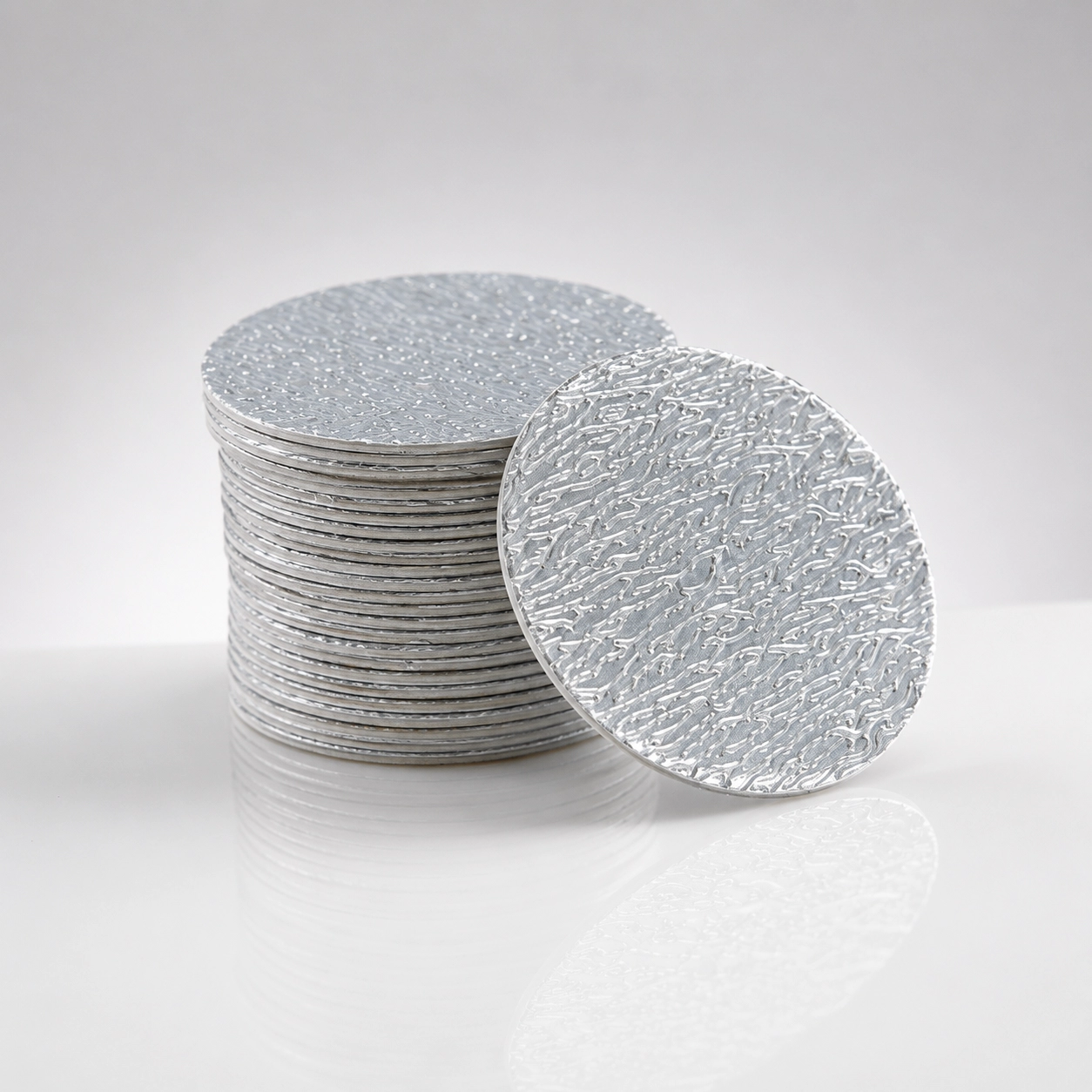
Quick answer: The backing is the layer furthest from the product and closest to the cap, and it is the layer that decides three things the specification rarely mentions: the total thickness that a cap sorter has to handle, whether the liner carries print well enough to be a brand surface, and whether the liner takes up moisture in a humid warehouse. Paperboard is the default for automatic sorters, EPE foam is for deep cap recesses and softer seating, and PET film is for humid or wet environments where paper is the wrong material.
In the liner structures we produce at Hangzhou Xinxing Pharmaceutical Packaging, the backing is the component where a change most often produces an unexpected complaint — and where the complaint rarely names the backing. It arrives as "the cap feeder jams", "the print looks washed out" or "the liners have gone soft in storage". All three are backing problems wearing a different label.
What the backing actually does, in four jobs
Job one — set the total thickness. The sealant and foil together are measured in fractions of a millimetre; the backing is measured in whole tenths. When a liner is described as 1.0 mm thick or 1.5 mm thick, the backing is doing almost all of that. Total thickness is what the cap recess has to accept, which is why it is the field a cap feeder acts on and a seal does not.
Job two — give the stack rigidity. Automatic cap sorters and orienters handle liners in bulk. A stack that flexes will not feed at a consistent rate; a stack that is too stiff will not release cleanly into the cap. Board sits in the middle of that range and is the reason it became the default.
Job three — carry the print. The top sheet is the branding surface, and the top sheet is the backing. Print quality on a coated board is the reference standard for liner printing; print on foam is softer and shows surface texture; print on film is sharp but demands a film-specific ink system.
Job four — resist or absorb moisture. Board takes up water from the air. In a humid warehouse that changes the stack height and the stiffness, which circles back to job two. Foam and film are closed-cell and are largely unaffected, which makes them the correct choice where humidity control is unreliable.
Paperboard
Use it when the line uses an automatic cap sorter, the liner carries a printed top sheet, and storage is dry. This is the majority of pharmaceutical and cosmetic applications, and board is the most economical of the three.
Coated versus uncoated. A coated board gives sharper print and a brighter white ground. An uncoated board takes ink into the fibre, which softens edges and reduces achievable type size — and which some food and chemical buyers actively prefer for a low-decoration pack.
The constraint to state in the specification. Grammage and caliper. Two boards of the same name can differ enough in caliper to change total thickness beyond what a feeder tolerates. Where a liner has been qualified on one board and a new stock arrives, caliper is the first measurement to take.
Where it fails. Humid storage, and caps with a deep recess where the board does not compress to fill the space. In a deep recess the cap can rock on the board rather than seat on the rim, which produces a leak that looks like an under-seal.
EPE foam
Use it when the cap has a deep recess, the closure is a tamper-evident band where a soft seat improves the feel of application, or the container rim is slightly irregular and a compressible backing helps distribute pressure.
What it buys. Compression. Foam deforms under cap torque, so it accommodates a rim that is not perfectly flat and a cap that is not perfectly square. Where a board backing produces channel leaks on an uneven rim, foam often resolves the leak without changing anything on the line.
What it costs. Foam is more expensive than board, and the softness that makes it useful makes it harder for a bulk feeder to handle. It also carries print less sharply, which matters if the top sheet is a brand surface carrying fine detail.
One caution. Because foam compresses, the same nominal total thickness behaves as a thinner liner under torque. When moving from board to foam at equal nominal thickness, re-check the cap for bottoming out.
PET film
Use it when the environment is humid or wet, the product is aqueous and the outside of the container is routinely wet, or the liner is specified for a market where storage conditions cannot be guaranteed.
What it buys. Dimensional stability. PET film does not take up moisture, so the stack height and the stiffness are the same in Singapore as in a dry European warehouse. For export programmes with long ocean transit and uncontrolled transhipment storage, that stability is often worth the premium on its own.
What it costs. The highest unit price of the three, plus a film-specific ink system for printed liners. It is also the stiffest option, which suits some feeders and not others.
Where it is the wrong answer. Where the cap requires compression to seat properly. A stiff film will not fill a deep recess, and the resulting leak looks exactly like the one foam was invented to solve.
The decision in practice
Three questions settle it, in this order:
Does the cap have a deep recess, or is the rim irregular? If yes, foam. If no, continue.
Is the storage or transit environment humid, or is the outside of the container wet? If yes, PET film. If no, continue.
Does the line use an automatic cap sorter and does the top sheet carry print? If yes, coated paperboard. If the answer is no to the sorter, uncoated board is usually adequate and cheaper.
Why this belongs on the specification
If the backing is not named, it will be chosen by default, and the default is whatever the supplier runs most of. That may well be correct — board is the right answer in most cases — but it will be correct by accident, and when the accident stops working, the conversation starts from a document that does not mention the component causing the problem.
Naming the backing, its grammage or density, and the total thickness it produces takes one line in a specification. It is the cheapest line in the document to write and the one that most often prevents a return shipment.