
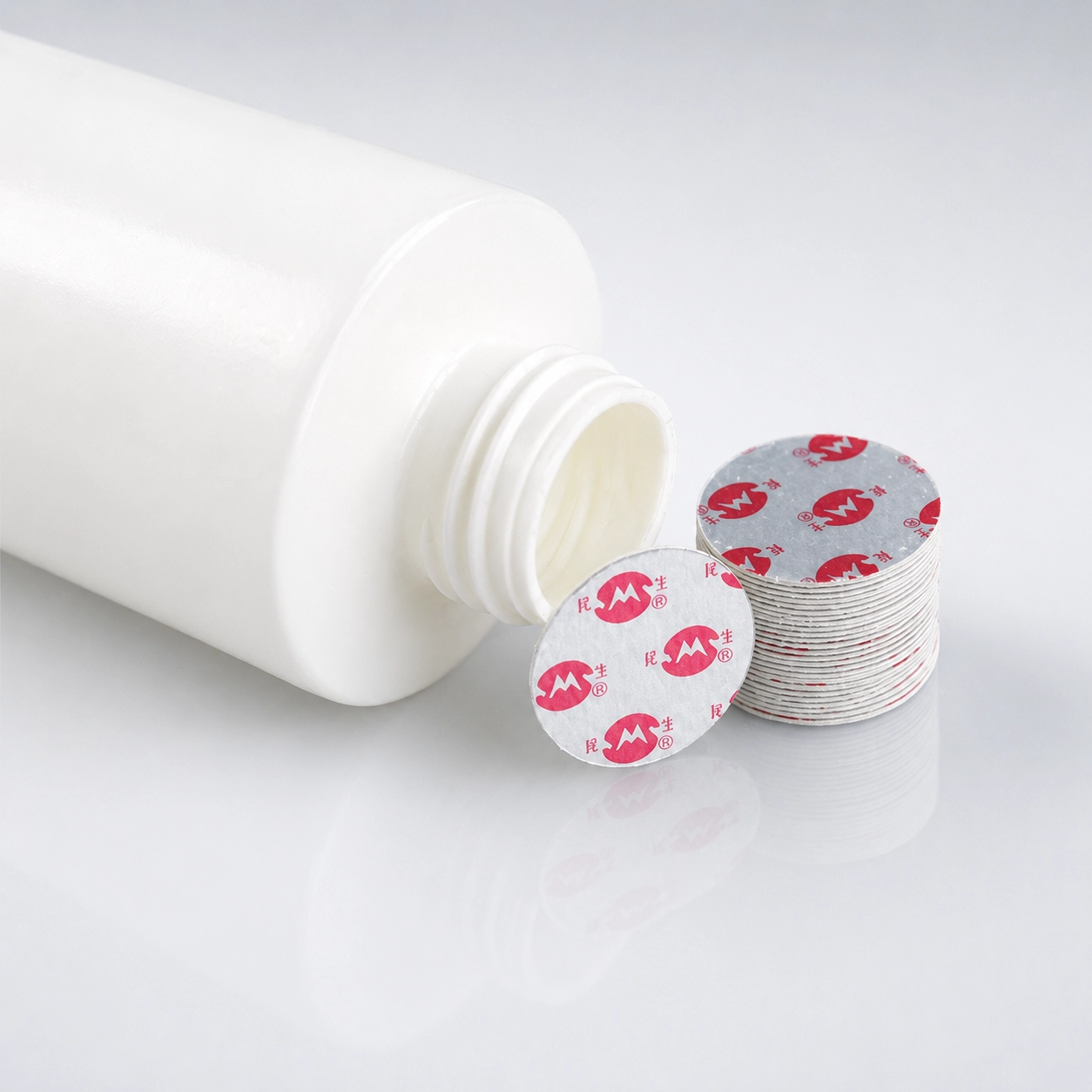
Quick answer: On a standard induction foil liner, the sealant film and the aluminium foil together account for the largest share of material cost, but the two largest controllable variables in a delivered price are annual volume against die amortisation and packing labour. Buyers who negotiate hardest on foil thickness usually move the price least, because foil is a minor cost component and a major performance component. The four levers that reduce cost without touching seal performance are volume consolidation, packing format, diameter standardisation and total thickness.
This is written for buyers who are being quoted a liner price and want to know which numbers in it are worth arguing about. It reflects the cost structure at our own production in Hangzhou, and it is expressed as proportions rather than figures, because absolute prices move with aluminium, polymer and freight markets and a fixed number here would be misleading within a quarter.
The material stack, layer by layer
Sealant film — the most expensive layer per unit area, and the one that decides the application. A PE film is the least costly, a PP film carries a premium for temperature resistance, PET a premium for chemical resistance, and a co-extruded multi-layer film a further premium for applications where no single polymer survives the product. Film cost also rises with thickness, and thickness is not a free variable: too thin and the seal has no peel strength, too thick and the sealant flows outside the sealing land during induction.
Aluminium foil — a commodity layer whose price tracks metal markets. Typically 20 to 40 µm. Foil is a small share of the total cost of the laminate but it is the layer buyers most often try to reduce, because thickness is the easiest number in the specification to see. Reducing foil thickness saves little and narrows the sealing window on lines with low-power equipment, which is the opposite of what a cost-reduction exercise should do.
Release layer — negligible in cost, disproportionate in importance. A microcrystalline wax or a light adhesive that holds the liner in the cap before sealing. It is one of the cheapest components and it is responsible for one of the most visible failure modes: liners dropping out of the cap feeder in warm conditions. Never reduce cost here.
Backing — the layer with the widest cost range. Coated paperboard, EPE foam, or PET film. Board is the most economical and is the default for automatic cap sorters because it gives the stack rigidity they need. Foam carries a premium and is justified where the cap has a deep recess. PET film carries the highest premium and is justified where moisture uptake in paper matters. Backing also determines total thickness, which is the variable that affects the cap feeder.
The non-material components
Die amortisation. A cutting die is a fixed one-time cost per diameter. Spread across a trial quantity of tens of thousands of liners, it can be a substantial fraction of the unit price; spread across a year of production volume at the same diameter, it becomes almost invisible. This is why the same liner quoted at a trial quantity and at an annual volume can differ by a factor that has nothing to do with the supplier's margin.
Printing setup. Colour separation, plate making and a proof round. A one-time cost per artwork, and the reason a two-colour design is dramatically cheaper than a four-colour design at low volume but only marginally cheaper at high volume.
Packing labour. Loose in poly bags, counted into cartons, or taped and reeled. This is labour rather than material, which means it does not benefit from volume the way material does. On small and medium orders it can exceed the material cost of the release layer and the backing combined.
Freight and volumetric weight. Liners are light and bulky. Freight is charged on volumetric weight, so packing density is a direct cost variable — a more tightly packed carton can reduce landed cost meaningfully on international shipments, and this is frequently overlooked when comparing two quotes.
Batch testing and documentation. Certificate of analysis, material declarations, migration testing where required. Modest on a standard order, material on a regulated one, and entirely avoidable only if the destination market does not require it.
The four levers that reduce cost without touching seal performance
Lever one — consolidate diameters. Every distinct diameter carries its own die and its own minimum run. A packaging range that uses four diameters where three would do is paying for an extra die and losing the volume leverage on the other three. Review the range once a year against the measured sealing lands; consolidating one diameter often pays for a year of liner purchases.
Lever two — specify the packing format to suit the line. Loose bags are the cheapest to produce and the slowest to use. If the capping line runs at speed, tape-and-reel or layer-packed cartons reduce line downtime enough to justify the labour premium. If the line runs slowly and manually, loose bags are correct. The mistake is accepting a default without checking which case applies.
Lever three — question total thickness, not foil thickness. Total thickness is driven by the backing. Moving from a heavy board to a lighter board of the same material, where the cap feeder tolerates it, reduces cost proportionally without affecting the seal at all — because the seal is made by the sealant film and the foil, not by the backing.
Lever four — buy the year, not the quarter. Because die amortisation and printing setup are one-time costs, and because material is bought against forecast, an annual commitment with scheduled releases typically beats four quarterly orders by more than the cost of holding stock. The constraint is warehouse space, and liners are bulky — so the calculation should be run on landed cost including storage, not on unit price alone.
What not to cut
Three components should be treated as fixed. The sealant polymer, because it is the only layer that contacts the product and the only layer whose failure mode is a delayed one that ships to customers. The release layer, because its failure mode is visible on the line and stops production. And batch testing, because a certificate of analysis is the only documentary defence available when a customer complaint arrives eighteen months after shipment.
How to read two quotes that differ by 40 percent
A price difference of that size between two liner quotes is almost never margin. It is one of four things: a different sealant polymer, a different total thickness, a different packing format, or a die that one supplier already owns. Ask which. A supplier who can name the specific difference is quoting against a specification; a supplier who cannot is quoting against a guess, and the guess will be resolved at your expense after the order is placed.