
Quick answer: A sealing liner specification that can be quoted without a follow-up question contains eight fields: measured sealing land diameter, container material, product type and aggressiveness, sealant polymer, foil thickness, total thickness, backing type, and packing format. Three of those — measured diameter, product aggressiveness and packing format — are the ones most often missing, and they are the three that change the price most. A specification without them produces quotes that cannot be compared.
Hangzhou Xinxing Pharmaceutical Packaging has quoted sealing liner requirements since 2001. The observation that follows is not about any one customer's competence: it is that liner specifications are often written by copying a previous supplier's part number, which encodes the answers without stating the questions. The result is a document that looks complete and cannot be verified.
The eight fields, and why each one changes the answer
1. Measured sealing land diameter. Not the neck finish designation, and not a nominal diameter from a closure catalogue. The flat annular area at the top of the neck, measured on a production-moulded container at three points around the rim. This field determines the cutting die, and the die is the only irreversible cost in the programme.
2. Container material. HDPE, LDPE, PET, PP, glass or coated board. The container material determines how heat transfers from the foil into the rim and how much the rim deforms under cap torque. A liner qualified on HDPE is not automatically qualified on PET, because PET transmits heat differently and has a higher softening point.
3. Product type and aggressiveness. The single most under-specified field. "Liquid" is not a specification. What matters is the carrier — aqueous, alcoholic, oily, solvent-bearing, acidic, alkaline — plus the fill temperature and the intended shelf life. This field alone decides the sealant polymer, and therefore a large share of the unit cost.
4. Sealant polymer. PE for aqueous and mildly aggressive products, PP for hot fill and higher temperature resistance, PET for oily and solvent-bearing formulations, and a co-extruded or multi-layer film where a single polymer cannot survive the product. State the requirement or state the product and let the supplier propose; do not state a polymer you have not validated against the fill.
5. Foil thickness. The heating element. Typically 20 to 40 µm. Thinner foil heats faster and suits lower-power sealers and higher line speeds; thicker foil holds heat longer and tolerates a wider gap between coil and cap. This is a line-capability field, not a quality field — a thicker foil is not a better liner.
6. Total thickness. Sealant plus foil plus release layer plus backing. Total thickness determines how the liner behaves in an automatic cap sorter: too thin and it does not fill the cap recess, too thick and it interferes with cap seating. This is the field that a cap feeder cares about and that specifications most often omit.
7. Backing type. Paperboard for rigidity in automatic sorters, EPE foam where the cap has a deep recess or where a softer seat is wanted, PET film where moisture uptake in paper is a concern. The backing also carries the print, so a printed liner's backing choice is constrained by the artwork.
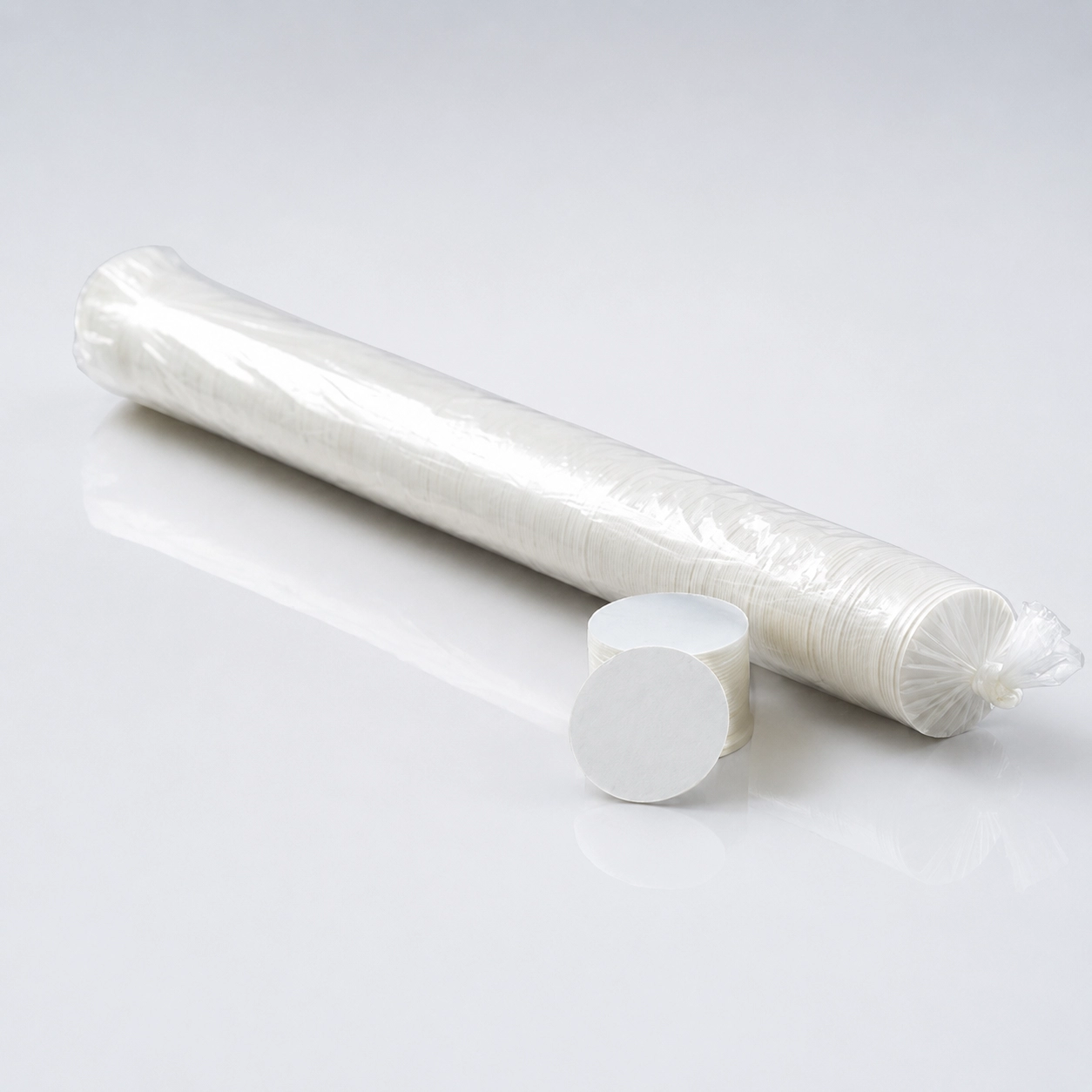
8. Packing format. Loose in poly bags by count, in layered cartons, or on a tape-and-reel for high-speed cap presses. Packing format affects the unit price more than most buyers expect, because it is labour rather than material — and it is the field that most often arrives after the quote, which forces the quote to be revised.
The three that get left out
Measured diameter. Substituted with the finish code, which describes the thread rather than the sealing land. Two containers sharing a finish can differ in effective sealing area by a millimetre or more, and a millimetre is the difference between a seal and a leak.
Product aggressiveness. Substituted with a product category. A "cosmetic cream" and a "cosmetic oil" have completely different effects on a PE sealant, and one of them will delaminate in storage.
Packing format. Left to the supplier's default, which is usually loose in bags because it is the cheapest to produce and the least convenient to use on a high-speed line.
A specification template you can reuse
Copy the following into a purchasing document and fill the blanks. It is deliberately short: every field below changes either the price, the tooling or the process window.
Application. Container type and material: ____. Nominal neck finish: ____. Measured sealing land outer diameter: ____ mm. Measured sealing land inner diameter: ____ mm. Rim flat width: ____ mm.
Product. Product description: ____. Carrier type (aqueous / alcoholic / oily / solvent / acidic / alkaline): ____. Fill temperature: ____ °C. pH: ____. Intended shelf life: ____ months. Any known aggressive ingredient: ____.
Construction. Sealant polymer (or "supplier to propose against product above"): ____. Foil thickness: ____ µm. Total thickness: ____ mm. Backing: board / EPE foam / PET film. Peel behaviour required: weld seal / peelable.
Line. Filling line speed: ____ containers per hour. Induction sealer make and model: ____. Coil-to-cap gap available: ____ mm. Capping method and torque range: ____. Cap feeder type: ____.
Commercial. Trial quantity: ____. Annual volume: ____. Packing format: ____. Destination market and any compliance declaration required: ____.
Why this produces comparable quotes
When two suppliers quote against this document, the difference between their prices is a real difference in construction, tooling or packing rather than a difference in assumption. That is the only condition under which a liner quotation can be compared at all — and it is worth the twenty minutes it takes to measure a container three times around the rim.