
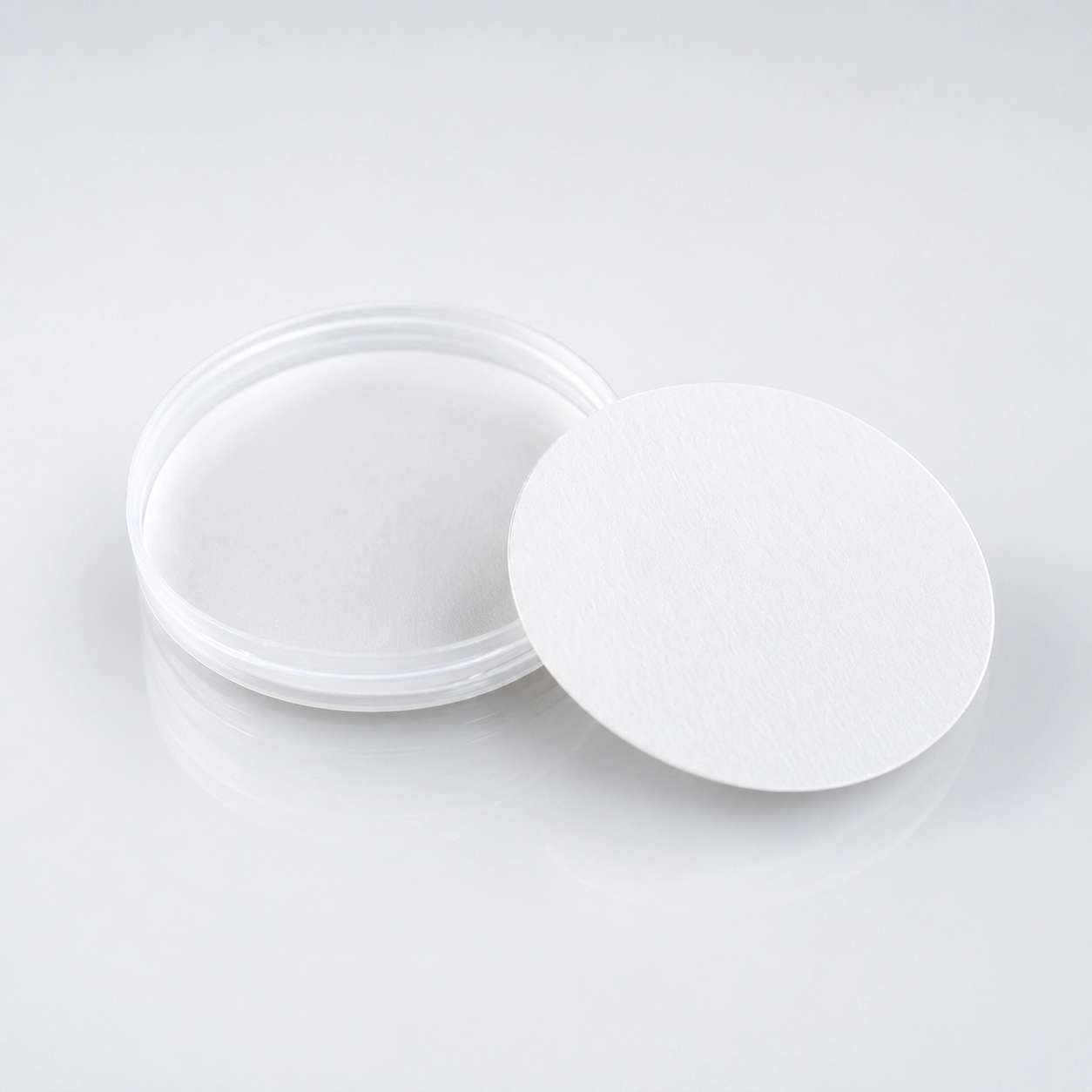
Quick answer: Most first enquiries about induction foil liners are really the same five questions in different wording: what does the liner seal to, why did a sample work when production did not, what is the smallest order I can place, what does tooling cost, and what paperwork will my auditor ask for. This page answers those twelve questions in the order they usually arrive, so a buyer can qualify a supplier before requesting samples rather than after.
Hangzhou Xinxing Pharmaceutical Packaging has manufactured sealing liners since 2001 for pharmaceutical, cosmetic, food and chemical packaging customers. The questions below are the ones that recur across nearly every new account, and the answers are written to be specific enough to act on: a number, a measurement, or a document name rather than a general reassurance.
1. What does an induction foil liner actually seal to?
The container rim, not the closure. The aluminium foil is heated by the electromagnetic field of the induction sealer, the sealant film on the liner face melts, and that film welds to the flat annular surface at the top of the bottle neck. The cap plays no part in the seal once the field has done its work — which is why an induction liner keeps sealing even if the cap is later removed and the product is decanted.
This single fact resolves a large share of specification errors. A buyer who specifies the liner against the closure will match thread and diameter correctly and still get a leak, because the closure dimension that matters is the bore and the sealing land underneath it.
2. Why did my sample seal perfectly but my production line leaks?
Almost always because the sample was sealed under different conditions from the line. A bench test applies heat and pressure for a generous dwell time with the container stationary. A production sealer passes the container under the coil at line speed, with a dwell measured in fractions of a second and a gap between coil and cap that varies with cap height tolerance.
The variables that differ are line speed, coil power setting, coil-to-cap distance, cap torque and the flatness of the sealing land. When we investigate a reported leak rate, the first request is always a video of the container passing the sealing head plus the actual power and speed settings. In most cases a liner that "failed" was never exposed to the conditions it was designed for.
3. What is the smallest order you will produce?
For a standard diameter and standard construction held in our range, the minimum is one carton of the stock size. For a custom diameter, the minimum is set by the economics of the cutting die plus a reasonable run length — typically in the low tens of thousands of liners per diameter, because the die itself is a fixed cost that does not scale down.
The practical advice is to separate the two questions. A trial quantity in a stock diameter can be shipped in days. A custom diameter trial requires the die, and the die is the expensive part, so the trial quantity should be large enough to run a full line qualification rather than a single shift.
4. What does tooling cost, and who owns the die?
A new cutting die is a one-time charge quoted per diameter. It is amortized into the unit price at higher volumes and charged separately at trial volumes. The die is retained for the customer's account and is not reused for another customer's specification, which is what makes the diameter a proprietary dimension rather than a catalogue item.
If the die already exists for your diameter — and for common pharmaceutical neck finishes it often does — there is no tooling charge at all. This is why the very first technical question in any custom enquiry is the seal diameter, before material, printing or packaging.
5. Which documents should I expect with a regulated order?
For pharmaceutical and medical device packaging, the standard set is a Certificate of Analysis per batch, a material safety data sheet for the sealant and adhesive layers, a declaration of compliance with food-contact or pharmaceutical-contact regulations as applicable in the destination market, and a migration test report where the product is a liquid or a fatty formulation. A sample retention policy that keeps a sealed reference from each batch is also standard practice.
What should not be assumed is that a supplier has these documents ready for your specific market. Regulatory declarations are jurisdiction-specific, and a compliant EU declaration will not satisfy a US or Gulf buyer without additional testing. Ask for the destination market at enquiry stage, not at shipment.
6. How long does production take?
Stock diameters in standard construction ship in roughly one to two weeks depending on quantity. Custom diameters add the die lead time, which is measured in days rather than weeks for a simple circular die, plus the sampling round. Printed top sheets add artwork approval and print setup, which is where most of the calendar time in a printed programme actually goes.
For planning purposes, the reliable approach is to ask for two dates: the date the first production sample can be sent, and the date of the first commercial shipment. The gap between them is where timelines slip.
7. Can the liner be printed with our brand?
Yes, on the top sheet — the surface the consumer sees when the cap is removed. Printing is applied to the board or film backing, not to the sealant film or the foil, so it has no effect on seal performance. Up to four colours plus varnish is the usual range, with one or two colours being the norm because the printable area is limited by the liner diameter.
Two practical constraints matter more than colour count. The first is that artwork must respect a bleed margin from the cut edge, because the die cuts the sheet and any design element within the tolerance band will look ragged. The second is that small text below roughly 4 pt is not reliably legible on a printed liner and should be replaced with a QR code or left off entirely.
8. Does the liner work with a product containing alcohol or oil?
It depends on the sealant polymer, not on the foil. A PE sealant is the workhorse for aqueous and mildly aggressive products. PP sealant resists higher temperatures and is the usual choice for hot fill. PET sealant is preferred for oily and solvent-bearing formulations where PE would swell. For products that attack all three, a co-extruded or multi-layer sealant film is specified instead.
The correct way to qualify is a compatibility soak: seal a set of containers, store them at elevated temperature for a defined period, then test peel strength and inspect the seal for channel formation. A liner that seals cleanly on day zero and delaminates in week six is the most expensive kind of failure, because it ships.
9. What shelf life should I expect in storage?
Unused liners in their original packaging, stored in a dry warehouse away from direct sunlight and heat sources, are normally warranted for twelve months from production date. The critical variables are humidity and temperature: the wax or hot melt release layer softens at elevated storage temperature, and moisture uptake in the paperboard backing changes the stack height and therefore the behaviour of automatic cap sorters.
Once a bag is opened, the clock accelerates. The recommendation is to consume opened packaging within the current production run rather than returning it to stock for the next campaign.
10. Can I use the same liner on different bottle sizes?
Only if the sealing land geometry is identical. Two bottles sharing a nominal neck finish can differ in wall thickness, rim radius and mould wear, and those differences shift the effective sealing area. A liner sized for the wider of the two will overhang on the narrower one, which produces a seal that looks intact but has an unbonded crescent at the rim.
In practice, group containers by measured sealing land diameter rather than by the finish designation printed in the closure catalogue. A single measurement on a production-moulded container, taken three times around the rim, resolves the question in under a minute.
11. What is the difference between one-trip and recloseable liners?
A one-trip induction liner is destroyed when the consumer opens the bottle — the foil tears away from the rim and reveals the printed top sheet. A foam liner, by contrast, is compressed against the rim by cap torque and reseals each time the cap is replaced. These are different products solving different problems, and a bottle cannot have both from a single liner.
Where both tamper evidence and reclosability are required, the usual construction is an induction liner for the primary hermetic seal with a foam or pressure sensitive disc on top, so the consumer breaks the foil seal and then relies on the secondary disc for resealing.
12. How do I qualify a new supplier without a full production trial?
Ask for three things before any order: a dimensional report on a production sample against your drawing, a sealing trial on your actual container and product at your actual line speed, and the compliance documents for your destination market. A supplier who can provide all three without a purchase order is a supplier who has done this before.
Once those are in hand, the remaining risk is batch-to-batch consistency, which is a manufacturing control question rather than a design question. Ask how sealant film thickness and die-cut diameter are measured in-process, and what the acceptance band is. A supplier who answers with a number and an instrument name is answering the real question.
Where to send the next question
If your question is not on this list, the fastest route is to send the container, the product and the line speed together. Those three inputs let us specify a liner construction and a sealing window in a single reply, instead of a back-and-forth about material grades that resolves nothing until the container is on a bench.